
This post was provided by News Now Warsaw
By Tom Davies
Indiana Capital Chronicle
A plan teased by some top Indiana legislators for eliminating homeowner property taxes is shrouded in silence.
Those lawmakers have remained tight-lipped about how they could pull off the multi-billion-dollar move — and key Statehouse interest groups that closely follow property tax issues are anxiously waiting for details.
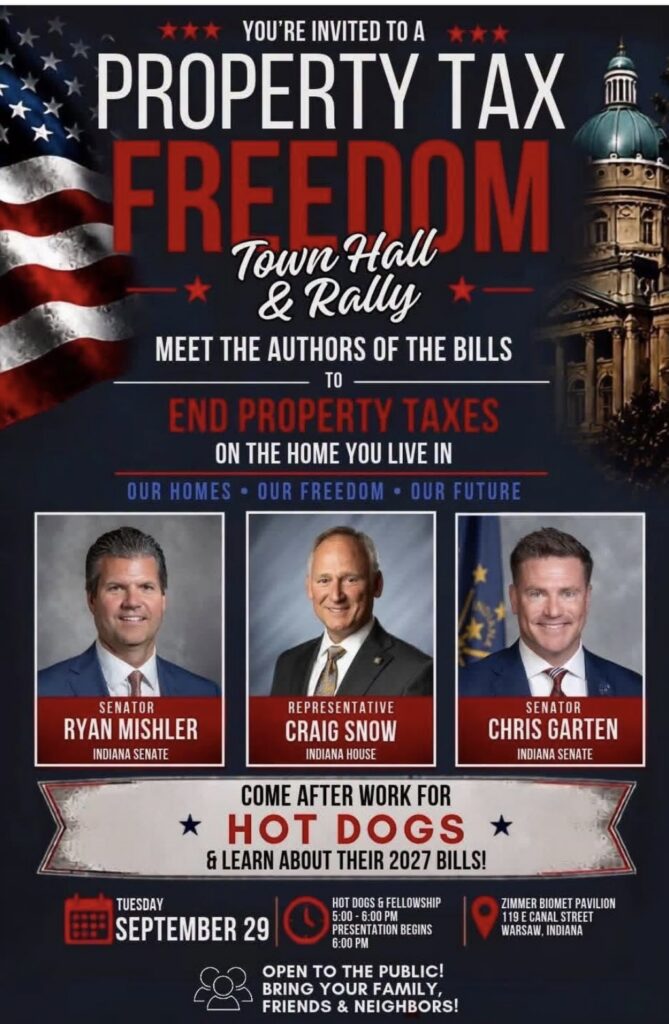
The plan “to end property taxes on the home you live in” was first touted with an Aug. 20 post to the campaign Facebook page of Republican Senate Appropriations Committee Chair Ryan Mishler.
The post promotes a “Property Tax Freedom” town hall and rally Sept. 29 in Warsaw, along with Rep. Craig Snow, R-Warsaw, and Sen. Chris Garten, who is poised to become the state Senate’s new Republican leader.
But they haven’t released any information about how they would eliminate the tax stream that provides much of the revenue for city and county governments and public school districts.
Even an apparent ally in efforts to dial back homeowner taxes — the group representing Indiana’s real estate agents — hasn’t been clued in on the plan.
“At least not to us at the state level,” Chris Watts, a vice president at the Indiana Association of Realtors, told the Capital Chronicle this week. “If they’ve consulted brokers locally, it’s not filtered up to us. So, yeah, we’re on pins and needles as well to kind of see what they’ve come up with.”
Neither Mishler nor Snow, who is vice chair of the tax code-writing House Ways and Means Committee, responded to multiple interview requests from the Capital Chronicle to their offices and their personal phone numbers.
Garten, R-Charlestown, declined an interview request via his office, which said he “is going to defer to Sen. Mishler.”
Questions abound about abolishment details
If such a major property tax proposal were to advance, it would undoubtedly become a leading topic of debate for the 2027 legislative session because of its wide-ranging impact.
Property taxes on owner-occupied homes amounted to nearly $4.1 billion, or 38%, of the $10.6 billion in statewide property taxes billed during 2025, according to a Legislative Services Agency report.
That percentage is expected to decline in comparison with business, industrial, rental and agricultural properties in the coming years under an overhaul enacted in 2025 with Senate Enrolled Act 1.
Questions abound, however, about how a homeowner tax elimination would work and how local governments and schools could replace such a large revenue source.
“Of course, it creates a huge concern for local units of government on how that money would be backfilled,” said David Bottorff, executive director of the Association of Indiana Counties. “I don’t know if it’s a goal or objective, if it’s something you’re trying to phase in over four or five years, all those details matter on what that transition would look like.”
Mishler, R-Mishawaka, has floated ideas for sizable homestead property tax cuts before.
One proposal came in a 2024 bill he filed that would have created a potentially $1 billion fund for homestead tax cuts from money that the state now directs each year toward a pension fund for teachers first hired before 1996. Mishler, who has been the Senate’s top budget writer since 2018, has pushed through several special state appropriations to build up that pension fund so that the annual spending is no longer needed.
But that money might not be available for a few more years — and would still fall short of the homeowner property tax collections.
Options to raise other taxes or cut local funding
The leader of the lobbying group for Indiana’s cities and towns said he and Mishler talked generally this summer about homeowner property tax elimination and that discussion included allowing more increases in local income taxes.
Mishler was “very clear that the revenue would have to be replaced,” said Matt Greller, CEO of Accelerate Indiana Municipalities.
A major worry for local governments comes from possibly facing higher interest rates on money borrowed for construction and other projects. That’s because payments for such bonds have long been guaranteed from property tax revenue that is regarded as more stable than income or sales taxes.
“Does it hurt us in the bonding market if we’re only using income tax to bond against?” Greller said. “Does the market look more or less favorably on that? What would that be in terms of increased interest costs?”
Legislators studied the prospects of abolishing property taxes in 2007. But they backed away after calculations showed a doubling or more of the state’s sales tax or income tax would be needed to raise a similar amount of money.
Those options of big hikes in other taxes — such as the 2.9% state income tax rate for 2026 — or squeezing the budgets of local governments and schools haven’t changed over time, said Larry DeBoer, a longtime Purdue University economist who has studied Indiana tax policy since the 1980s.
“An income tax rate of 6 or 7 (percent) would probably do it, and that’s what has discouraged people in the past,” DeBoer said in an interview. “But we’re in an age of reform, I guess.”
“More questions, certainly, than answers”
Other property tax cut ideas are also being talked about, such as Gov. Mike Braun’s suggestion of ending home taxes for those older than 65 who’ve paid off their mortgages.
Another proposal from a Republican legislator would eliminate all property taxes and replace that revenue by extending the state’s 7% sales tax to include a vast array of currently untaxed services such as haircuts, construction labor costs and lawyer fees.
Indiana School Boards Association Executive Director Terry Spradlin said he has “more questions, certainly, than answers” about the homestead tax abolishment suggested by Mishler, Snow and Garten.
“It’s a very vague concept that only the flyer speaks to, without a plan to explain it,” Spradlin said. “So we’re all anxious to get more detail.”
The legislators are seizing upon a topic that has been a top campaign issue in recent years — and could push their proposal forward during the 2027 legislative session that starts in January.
“Those three are high-profile leaders of the House and Senate Republican caucuses,” Spradlin said. “So this has some merit, obviously, that we need to pay attention to.”